
Flights to Ireland: airports, fares and travel planning
Compare arrival cities, airport options and recent fare signals for a more confident journey to Ireland.
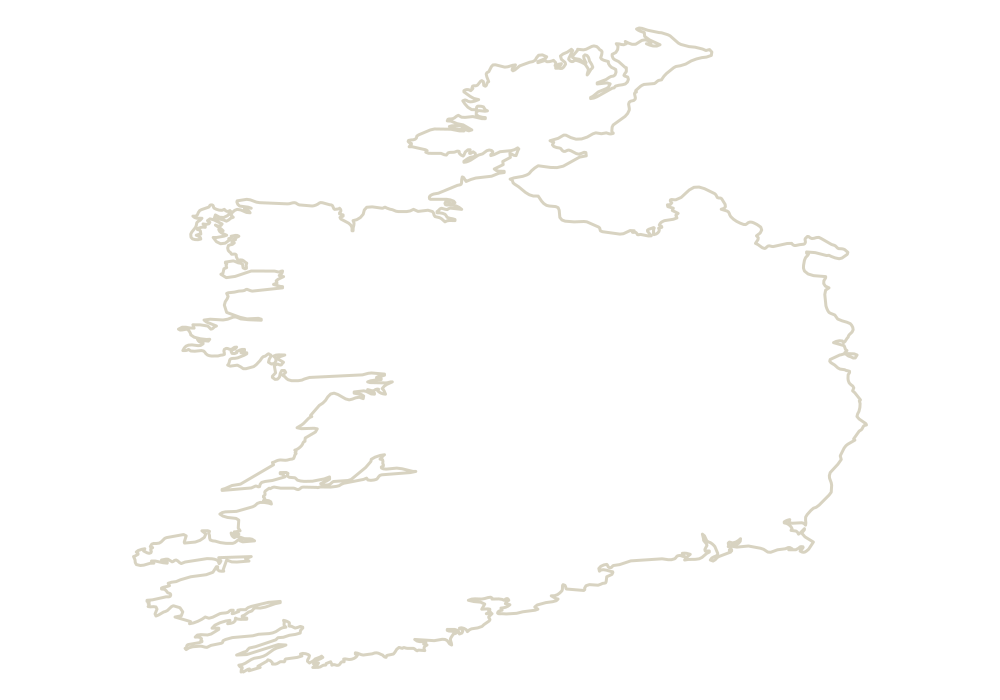
Current fare signals for flights to Ireland
Lowest recently observed one-way prices by departure month. Empty months do not yet have enough current data.
Explore Ireland arrival airports
Compare the main airport options before selecting a flight.
Dublin Airport (DUB)
Most connected airport option

- Serving Dublin
- 17 km by road
- About 25 min by car
- 307 direct route signals
Cork Airport (ORK)
Alternative arrival option

- Serving Cork
- 8 km by road
- About 10 min by car
- 80 direct route signals
Shannon Airport (SNN)
Compare before booking
- Serving Shannon
- 7 km by road
- About 12 min by car
- 28 direct route signals
Ireland West Airport Knock (NOC)
Compare before booking

- Serving Knock
- 20 km by road
- About 18 min by car
- 28 direct route signals
Kerry County Airport (KIR)
Compare before booking

- Serving Kerry County
- 5 km by road
- About 9 min by car
- 12 direct route signals
Waterford (WAT)
Compare before booking

- Serving Waterford
- 9 km by road
- About 13 min by car
- 8 direct route signals
Donegal Airport (CFN)
Compare before booking

- Serving Carrickfinn
- 0 km by road
- About 1 min by car
- 4 direct route signals
Inisheer (INQ)
Compare before booking

- Serving Inisheer
- 0 km by road
- About 1 min by car
- Direct signals updating
Letterkenny (LTR)
Compare before booking

- Serving Letterkenny
- 0 km by road
- About 1 min by car
- Direct signals updating
Inishmaan (IIA)
Compare before booking

- Serving Galloway
- 2 km by road
- About 5 min by car
- Direct signals updating
Flights to Ireland: what you need to know
Flights to Ireland can lead to very different journeys depending on the arrival city, the airport named on the ticket and the plan after landing. This guide brings together current route signals, airport reference data and practical booking checks so that a traveller can compare the entire trip instead of only the first fare shown in a search result. It is designed for a short city break, a longer regional itinerary or a first visit where the arrival point is still undecided.
Arrival cities currently represented in the guide include Dublin (DUB), Knock (NOC), Cork (ORK), Shannon (SNN), Kerry County (KIR), Carrickfinn (CFN), Waterford (WAT), Bantry (BYT), Belmullet (BLY), Galloway (IIA), Galway (GWY), and Inisheer (INQ). A country page is useful for comparing the broad options, but the city page is where the final airport, transfer and recent route details become clearer. This matters most when a country has more than one plausible arrival point: choosing the lowest headline fare can add an inconvenient last leg if the airport does not serve the part of the country you intend to visit.
Ireland currently has airport reference entries including Dublin Airport (DUB), Cork Airport (ORK), Ireland West Airport Knock (NOC), Shannon Airport (SNN), Kerry County Airport (KIR), Waterford (WAT), Donegal Airport (CFN), and Bantry (BYT). These are practical starting points for comparing an arrival, not a promise that every airport has the same timetable or connections on every date. The available route reference contains 233 direct-route signals across these listed airport options. A signal helps to frame a search, but the live result determines whether a nonstop itinerary is actually offered for your dates.
Recent monitoring has recorded one-way fare signals to Ireland from EUR 16. This is an observed starting point rather than a guaranteed fare. It can change with date, airline, baggage, point of sale, passenger count and the moment the partner search is opened. Use a current signal to decide which dates deserve a closer comparison, then check the full live itinerary before payment.
Recent route observations include departure cities such as Dublin (DUB), London (LON), Manchester (MAN), Alicante (ALC), Faro (FAO), and Barcelona (BCN). They are examples from the current reference, not a timetable or an exhaustive list of ways to reach Ireland. Availability changes by weekday, season and carrier. Compare your nearest departure point with only the alternatives that still make sense for the full door-to-door journey.
When comparing flights to Ireland, separate the fixed parts of the trip from the flexible ones. Start with dates that are essential, then test a small number of nearby days only if the schedule allows it. Compare the airport code, departure and arrival times, cabin and checked-bag conditions, change rules, any connection requirements and the final transfer to accommodation. A ticket that is cheaper before these details are added is not automatically the better-value journey. This is particularly true for late arrivals, short breaks, families, travellers with checked bags and trips that depend on reaching a regional destination after landing.
Airport choice should be treated as part of route choice. A city label can cover a central airport, a regional airport or several airports at very different distances from the intended destination. Use the three-letter IATA code to identify the actual arrival point, then check the transfer options at the scheduled landing time. Road distance is useful reference information but it does not guarantee public-transport frequency, late-night availability, traffic conditions or the cost of the onward leg. If the itinerary has a connection, review the transfer airport separately and confirm whether the journey is protected on one ticket.
Before booking, confirm the information shown by the airline or booking partner for your exact dates. Check the final price, baggage allowance, seat and payment conditions, cancellation and change rules, transit requirements and any passport, visa or entry rules that apply to your own nationality. These requirements cannot be inferred safely from a country guide because they depend on the traveller, route and date. Keep the airport code and fare conditions with the booking confirmation so that alternatives can be compared accurately if the plan changes.
GoViaWay uses observed fare signals and route reference data to support planning, then sends a traveller to an external partner for live availability and booking. Schedules, price and final ticket terms are confirmed in that live result. The useful approach is to let the country page narrow the research, open the relevant city or route page for practical context, and make the final decision only after the exact itinerary has been checked. That gives the headline price the context it needs before payment.
Travellers arriving late, travelling with children or carrying checked baggage should give added weight to the final transfer. Check whether rail, coach, shuttle or taxi options are still running at the scheduled landing time, whether a reservation is needed and what happens when a flight is delayed. A route that works well in daytime may be much less convenient after the last connection.
FAQs about flying to Ireland
Answers use the current airport, route and fare reference data.
Which airport should I choose for Ireland?
Dublin Airport (DUB) is the first airport option in the current route reference for Ireland. Compare it with the city or region you plan to visit, your arrival time and the live itinerary before choosing a ticket.
How far are Ireland airports from their cities?
Current airport reference entries include DUB: 17 km and about 25 minutes by road, ORK: 8 km and about 10 minutes by road, NOC: 20 km and about 18 minutes by road, SNN: 7 km and about 12 minutes by road, KIR: 5 km and about 9 minutes by road, WAT: 9 km and about 13 minutes by road, CFN: 0 km and about 1 minutes by road, and BYT: 3 km and about 5 minutes by road. Road conditions, terminal location and public-transport timetables can change the actual transfer.
Are there direct flights to Ireland?
The current route reference contains 233 direct-route signals across the listed Ireland airport options. This is not a promise of a nonstop flight on every date; confirm availability for your exact search.
How can I find cheaper flights to Ireland?
There is not yet a recent fare signal that meets the freshness rules used on this site. Search a range of dates and compare the full ticket conditions rather than relying on an older advertised price.
Which arrival cities should I compare in Ireland?
The country guide currently includes arrival cities such as Dublin (DUB), Knock (NOC), Cork (ORK), Shannon (SNN), Kerry County (KIR), and Carrickfinn (CFN). Choose the city or region you actually want to reach first, then compare the airport and final transfer rather than choosing only by the lowest fare.
Which departure cities have recent signals to Ireland?
Recent observations include departures such as Dublin (DUB), London (LON), Manchester (MAN), Alicante (ALC), and Faro (FAO). These are examples from available route data, not a fixed timetable. Compare them with the airport nearest to you and the actual dates you need.
What should I check before booking flights to Ireland?
Confirm the airport code, departure and arrival times, baggage allowance, ticket change and refund rules, connection requirements and the final transfer. Check entry, visa and document requirements for your own nationality in official sources before travel.
Should I compare more than one airport in Ireland?
Yes, when more than one airport or arrival city appears in the search. Compare the whole door-to-door journey: fare, airport, transfer, arrival time, baggage conditions and the cost of reaching your final destination.